AFTERWORD

Updated: Feb 7

The PostHuman Saga
by Agron Shehu
The PostHuman Saga is a philosophical science-fiction trilogy that examines humanity through the lenses of science, history, and speculative futures. Developed from the perspective of an engineer observing technological transformation across decades, the series explores how intellect, emotion, and energy systems shape civilizations — and how those forces may influence humanity’s trajectory beyond Earth.
Rather than focusing solely on adventure or spectacle, the trilogy combines narrative storytelling with reflective inquiry. It spans shifting timelines, planetary environments, and altered states of existence — including biological evolution, mindwave entities, and interspecies encounters — while remaining anchored in recognizable human dilemmas.
At its foundation lies a persistent theme:
How do reason and feeling interact to shape human progress — and what might emerge when humanity acquires the power to redefine itself?
The books do not impose conclusions. They present evolving scenarios that allow readers to observe transformation, responsibility, and restraint as lived experiences within the narrative.
Humanity in Transition
Humans in SpaceTime… What a Shock
The first volume introduces humanity as both observer and subject of its own history. Through the interaction of symbolic characters representing intellect and emotion, the narrative revisits cultural development, conflict, and discovery across time.
Humanity is portrayed as neither completed nor fixed, but as a species actively defining itself — learning through contradiction, ambition, and reflection.
PostHumans
The second volume explores transformation driven by technological and genetic advancement. Boundaries between biological identity and intellectual existence begin to shift, raising questions about agency, governance, and ethical responsibility.
The story examines the complexity of progress: how expanded capability does not automatically resolve inherited dilemmas, and how evolution introduces new responsibilities alongside new freedoms.
Alpha~C | The Silence Beyond Light
The trilogy’s third volume expands outward toward interstellar encounter. Humanity approaches another inhabited world and must determine how to engage without domination or disruption.
Here, expansion becomes a test of restraint and coexistence. The narrative emphasizes measured decision-making, highlighting maturity as an operational challenge rather than an abstract ideal.
Energy and Civilization
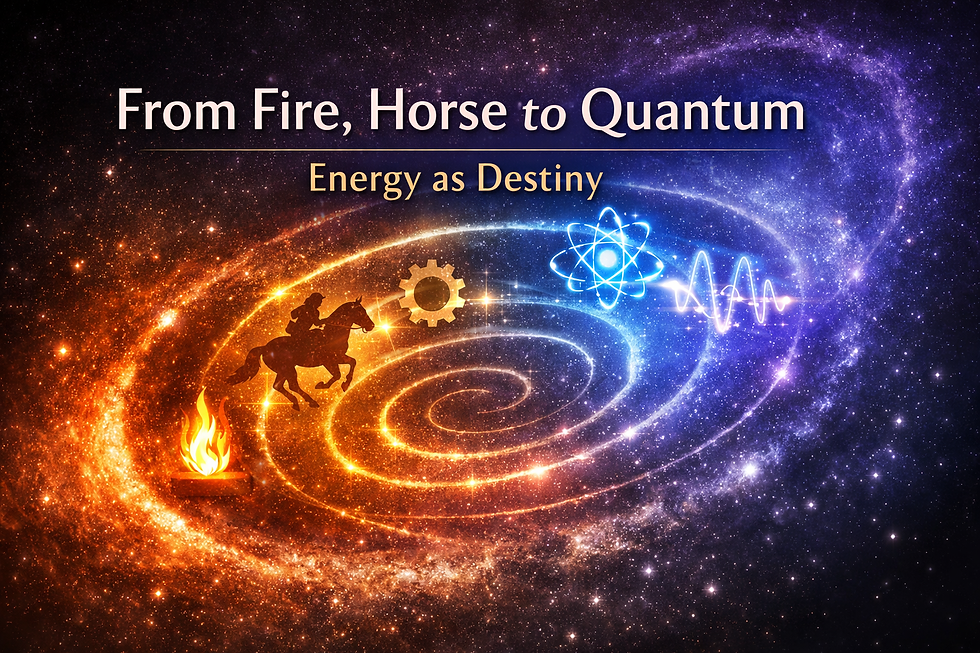
A continuous thread throughout the saga is the role of energy transitions in shaping human systems. From early fire, horse to industrial hydrocarbons, nuclear processes, and speculative quantum frameworks, shifts in energy capability influence:
Social structures
Economic priorities
Technological imagination
Environmental interaction
Energy is presented not only as physics, but as a structural driver of historical direction.
Mind and Feeling
Central narrative figures embody cognitive and emotional modes of decision-making. Their interaction illustrates how civilizations are shaped by both rational analysis and emotional impulse.
Neither mode dominates the narrative. Instead, their tension produces outcomes that range from constructive cooperation to destructive imbalance — reflecting observable patterns within human experience.
Origins of the Work
The trilogy draws from a lifetime of professional engagement with engineering, energy systems, and cross-cultural observation. Exposure to rapid technological advancement alongside persistent moral complexity inspired the central inquiries embedded in the narrative.
Science fiction provided a medium capable of extending those observations beyond current limitations, allowing exploration of consequences at planetary and interstellar scales.
Continuing the Dialogue
The conclusion of The PostHuman Saga is intentionally open-ended. The work encourages readers to reflect on ongoing questions such as:
How should humanity define itself as technology evolves?
What responsibilities accompany increased capability?
How should advanced civilizations interact with others?
What values must remain constant through transformation?
These considerations extend beyond fiction and into real-world discourse about human development.
Closing Perspective
The trilogy portrays humanity as a dynamic and unfinished system influenced by knowledge, emotion, and power. Its narrative suggests that future progress — whether technological, biological, or exploratory — will ultimately depend not only on capability, but on judgment.
The future remains probability. And within that uncertainty lies both challenge and possibility.
These themes are explored in greater depth throughout The PostHuman Saga,
particularly in PostHumans and Alpha~C | The Silence Beyond Light
where the tension between intellect, emotion, and technological evolution
forms the narrative core.


Comments