Why I Created The PostHuman Saga

Updated: Feb 7
The Question That Became The PostHuman Saga
By Agron Shehu
I did not begin The PostHuman Saga as a story about space.
I began it as a question about human limits.
After a lifetime working in engineering and energy systems — observing how civilizations harness power, transform resources, and extend their reach — I came to recognize a troubling asymmetry: technological progress advances with relentless speed, yet moral progress moves uncertainly, sometimes not at all. Humanity learns to conquer distance before it learns to understand itself.
From this realization emerged a doubt that refused to disappear:
If humanity escapes Earth — will it carry its problems with it, or finally transcend them?
That doubt became the seed of the saga.
Humanity as a Transitional State
The trilogy explores humanity not as a finished condition, but as a phase — an evolving state suspended between instinct and awareness.
Higgs embodies intellect. Hitt (Hitler) embodies emotion. Quark serves as an external mirror — an intelligence capable of observing humanity without belonging to it. Ellie represents probability — not what is, but what might become.
Through them, the narrative examines a persistent internal struggle that shapes civilizations:
Mind vs. Feeling
Reason without empathy risks sterility. Emotion without reflection risks chaos.
Human history — and perhaps its future — unfolds through their uneasy negotiation.
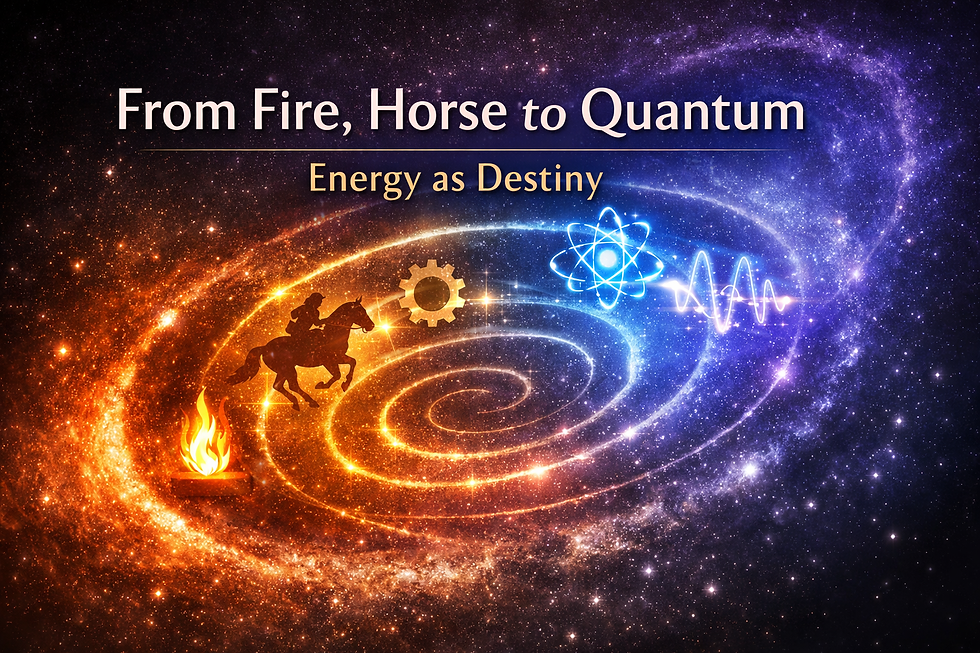
Energy as the Architect of Civilization
Running beneath the saga is another continuum: the evolution of energy.
From fire, horse to hydrocarbons, from nuclear potential to quantum speculation, each transformation alters not only capability, but identity. Energy determines:
social structure
moral priorities
technological imagination
humanity’s relationship with its environment
Civilization is not shaped solely by ideas — but by the forces that enable ideas to manifest.
In this sense, energy becomes culture’s silent architect.
The PostHuman Threshold
As the narrative progresses, humanity encounters transformation — biological, intellectual, and ethical. Power over life, consciousness, and expansion introduces unavoidable questions:
Who directs evolution?
What responsibility accompanies knowledge?
Can intelligence advance without domination?
This inquiry culminates in what I call The Humility Framework — the proposition that a truly advanced species must learn to expand without conquest, influence without corruption, and evolve without erasing its origins.
The saga therefore is not about aliens.
It is about whether intelligence itself can mature.
A Personal Reflection
Writing these books has been more than storytelling. It has been reflection shaped by decades observing human capability — its brilliance and its contradictions — through science, engineering, travel, and contemplation.
I have witnessed extraordinary innovation alongside recurring moral struggle. That coexistence inspired both admiration and concern:
Wonder at human creativity
Concern for the direction of its power
Science fiction offers the rare freedom to explore these tensions beyond the constraints of present reality, while remaining anchored in human truth.
An Invitation
This saga does not attempt to provide final answers.
Instead, it invites readers to continue asking:
Does technological progress produce moral progress?
What defines humanity’s identity?
Should we remain human — or become PostHuman?
How should intelligence meet the unknown?
If these questions persist after the final page, then the purpose of the work has been fulfilled.
Closing Thought
Humanity may travel beyond Earth, beyond biology, perhaps even beyond physical form. Yet progress will ultimately be measured not by distance crossed or power obtained — but by the wisdom with which consciousness encounters what lies ahead.
The future remains unwritten.
And within that uncertainty lies both responsibility and hope. These themes are explored in greater depth throughout The PostHuman Saga, particularly in Humans in SpaceTime… What a Shock and PostHumans, where the tension between intellect, emotion, and technological evolution forms the narrative core.
→ Read more on the Books page.


Comments